7 Easy Space Activities for Children to Try at Home
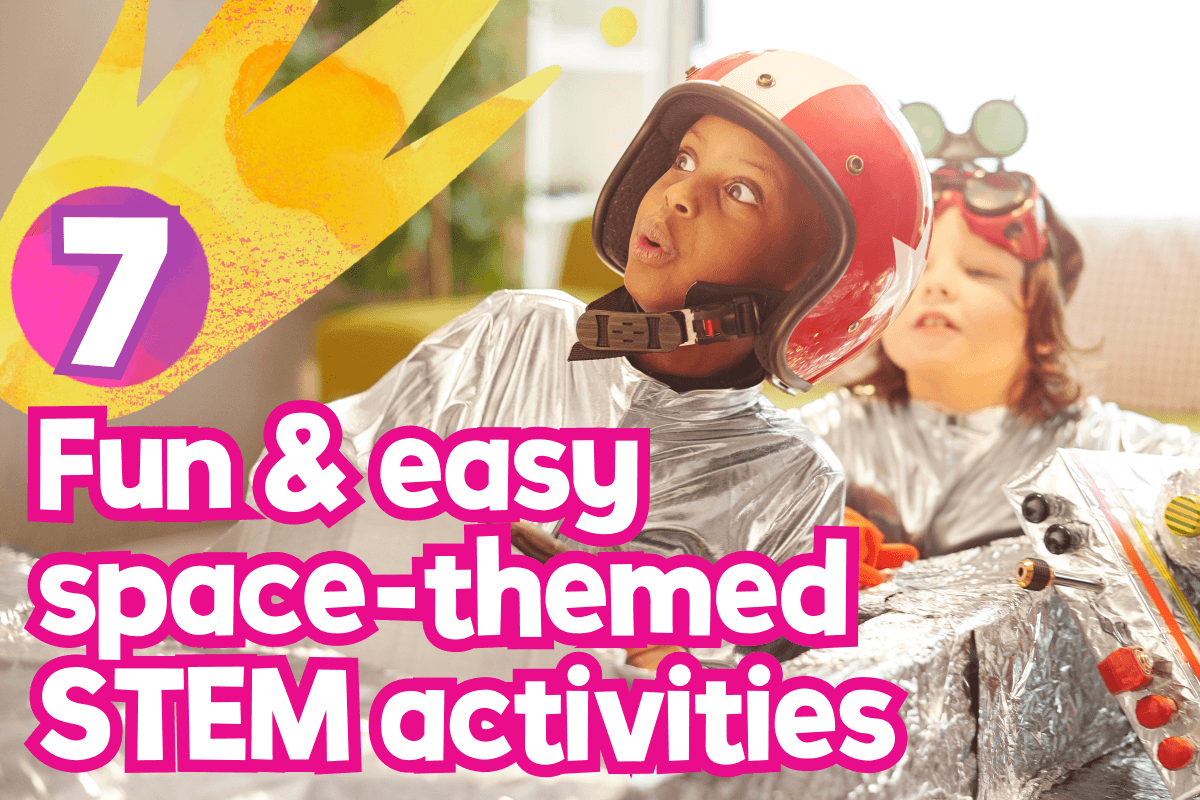
Has your family been following the recent space launches? Space is one of those topics that children can get really into – rocket launches, far-off planets, astronauts, stars at night, black holes… it’s exciting, and there’s plenty to explore.
Here are 7 easy space-themed ideas to try at home. They’re quick, easy-to-set-up STEM activities that will capture their imagination and get them thinking.
You don’t need to be an expert on space either. Each activity includes a few simple talking points so you can explore it together as you go.
If you happen to be marking World Space Week, you could use one each day. But they work just as well on a random Tuesday when someone suddenly decides they love space!
If you’re looking for more space-themed ideas, take a look at our other blogs:
Space Activities for Children – FREE Printable Space Activity Pack
Space-Themed Activities – Ideas to Make Their Space Day Out of This World!
You’ll also find plenty of space-themed games and activities on Busy Things.
Space activity ideas to try at home
- Rocket Quest – Balloon Rocket Science Experiment
- Cosmic Craft – DIY Constellations
- Space Recyclers – Build a Rocket from Recycled Materials
- Solar Explorer – Make a Solar-Powered Oven
- Earth from Above – Paint Your Planet
- Astronaut Fitness Challenge – Space Walk Obstacle Course
- Stargazing – Look up!
- Free Space Activity Pack
1: Rocket Quest – Balloon Rockets Science Experiment
Blast off with a simple balloon rocket
This is a really easy one to start your space adventure with and takes just a couple of minutes to set up. It’s a great way to show how rockets move.
What You’ll Need:
- A balloon
- A piece of string
- A straw
- Tape
How to Launch a Balloon Rocket:
- Thread the string through the straw and tie the string between two points (a couple of chairs works fine).
- Inflate the balloon but don’t tie it. Tape the balloon to the straw.
- Let go of the balloon and watch as it zooms along the string like a real rocket!
- Try it again with different balloons or string lengths and see what changes.
Watch it in Action: Balloon Rocket Science Experiment for children
Fun Space Facts:
Rockets use fuel to create thrust, just like the air in the balloon. The shape of the rocket affects how it moves – you could experiment with different-shaped balloons and see what happens.
Rockets and satellites help scientists learn about our planet and space. They’re used to monitor things like weather, climate and changes on Earth, including melting ice in the Arctic.
For more cool space facts explore NASA’s Solar System Exploration for Kids.
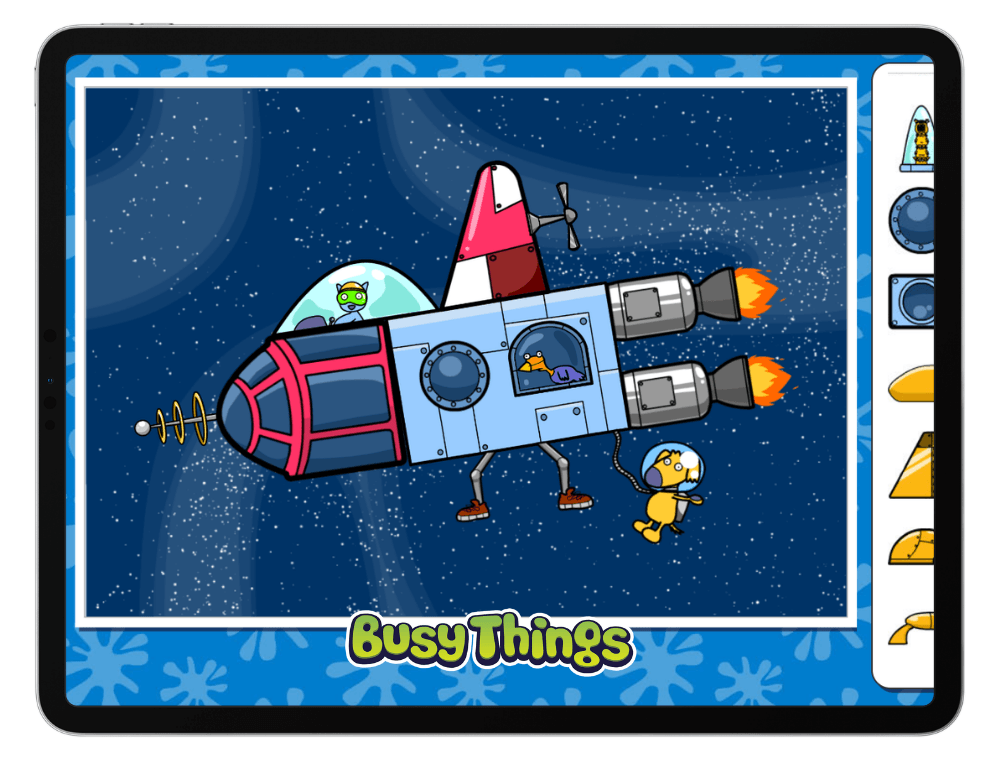
Design a spacecraft on Busy Things
Let them design their own rocket – experiment with shapes, colours and features and think about what a spacecraft actually needs.
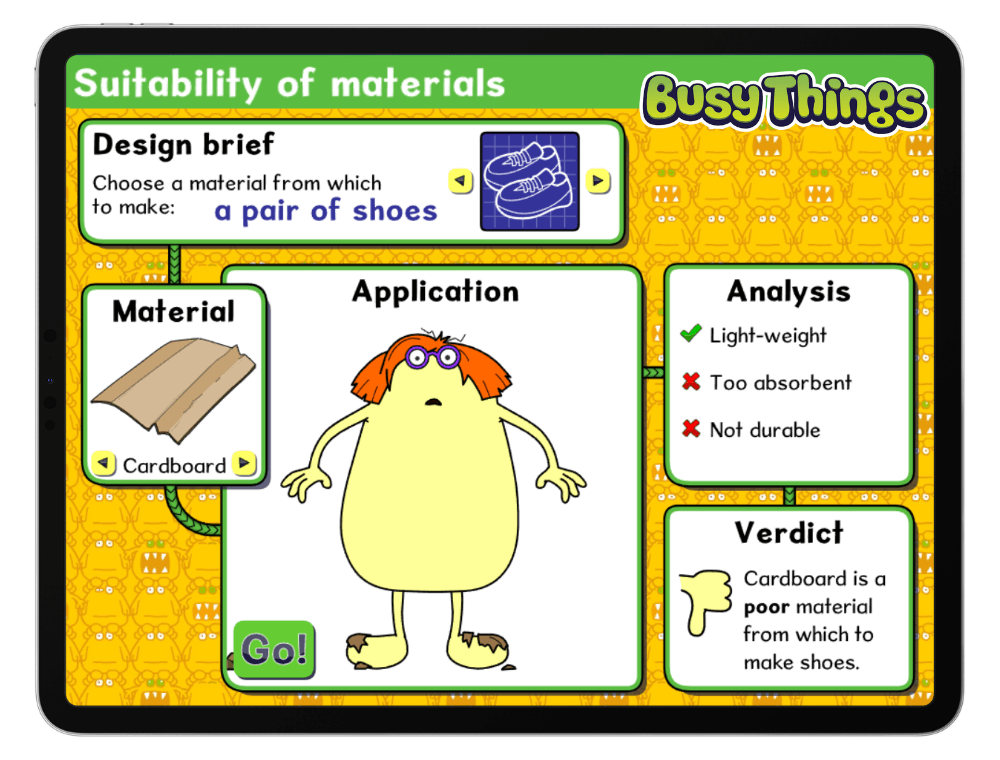
Think about suitability of materials on Busy Things
You could also explore which materials would work best for different parts of a rocket – what needs to be strong, heat-resistant or flexible?
2: Cosmic Craft – DIY Star Constellations
Create Your Own Starry Night!
Ready to explore the night sky? Transform your space into a mini planetarium with this DIY constellation craft. It combines art with science, is quick to set up and works well as a calmer activity.
What You’ll Need:
- Black paper
- A torch
- A toothpick
How to make your constellations:
- Use the toothpick to carefully punch holes in the black paper to create star patterns. You could copy well-known constellations like Orion or the Plough, or make up your own.
- Tape the paper over the torch.
- Turn off the lights and shine it onto the wall or ceiling to project your “stars”.
Fun Star Facts
Constellations are patterns of stars that people have grouped together over time. They were often used for navigation and storytelling.
Watch this video to learn about the types of constellations, their names, and how to find them.
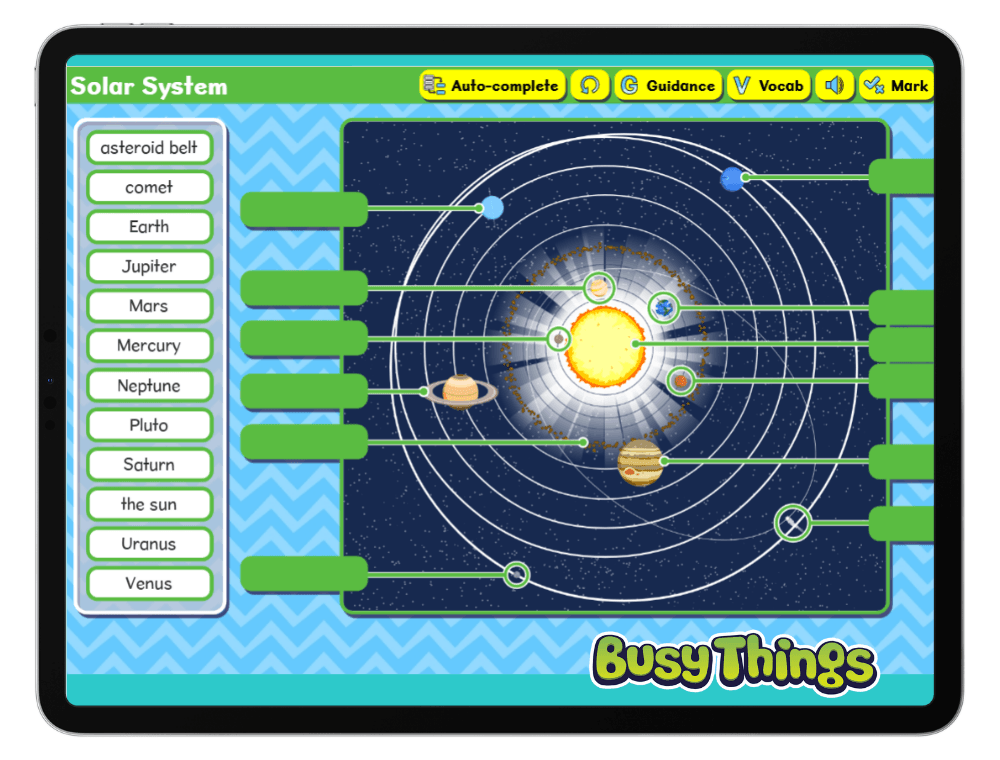
Explore the solar system on Busy Things
Use the label the solar system activity on Busy Things to help children see where the planets sit in relation to each other, and start to understand what else is out there beyond the stars.
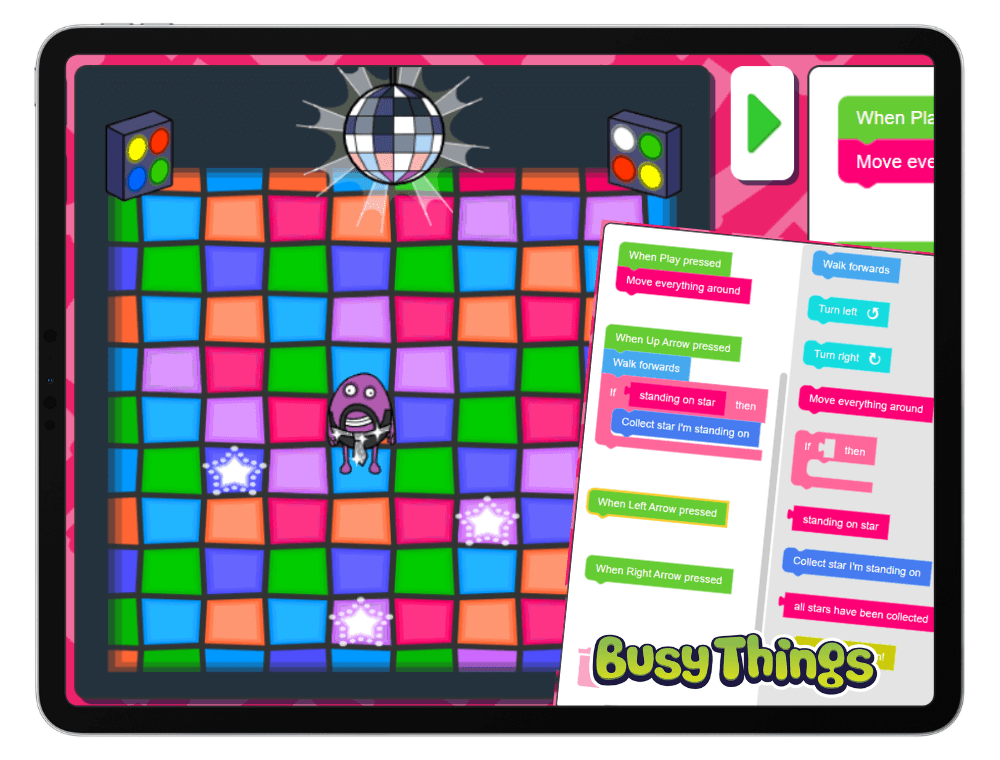
Collect the stars coding game on Busy Things
If they enjoy a bit of problem-solving, try the ‘collect the stars’ coding activity. Children can create a simple game using code, while keeping the star theme.
3: Space Recyclers – Build a Rocket from Recycled Materials
Build a rocket from things you already have
This “Space Recyclers” activity turns everyday household items into a rocket. This eco-friendly craft is a creative way to explore how rockets are designed, while also making use of things you’d usually throw away.
What You’ll Need:
- Any carboard boxes, tubes or plastic cartons
- Paint
- Tin foil
- Scrap paper
How to build a space rocket:
- Wrap a tube or box in tin foil to give it a metallic look.
- Add fins using scrap paper or cardboard, then decorate it however you like.
- Keep it simple or go all out – windows, flames, control panels… whatever they think a launch-ready rocket needs!
A Cosmic Conversation Starter:
Rockets are carefully designed to travel through the atmosphere and into space. Their shape, size and materials all play a part in how they work. You could ask:
- What does a rocket need to travel into space?
- What tools or gadgets might an astronaut need?
- What might it need to carry?
- Where is it going?
Recycling and waste isn’t just a problem here on Earth. There’s a growing problem with space debris – old satellites and pieces of rockets left floating in orbit. Scientists are working on ways to clean it up and make space safer for future missions. You can learn more about space junk and how it’s managed in this Newsround article.
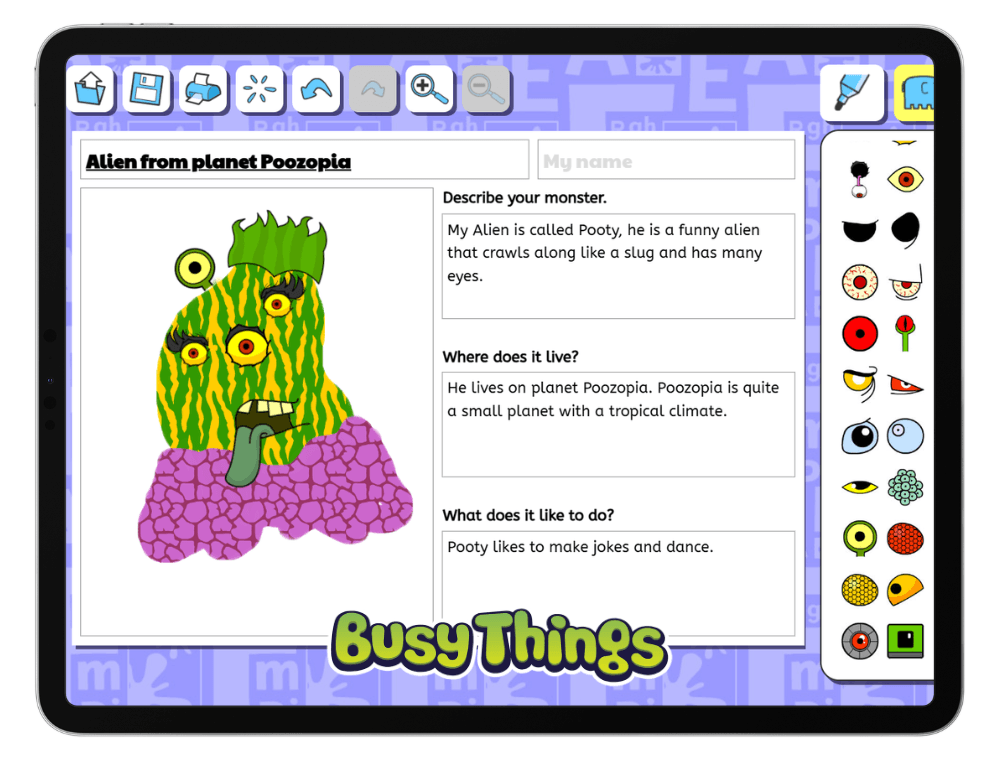
Design an alien on Busy Things
Once they’ve launched their rocket, the next question is – who might they meet in space?
Use the design a monster activity on Busy Things to create an alien. They can experiment with different features, then describe what it looks like, where it lives and what it likes to do.
4: Solar Explorer – Make a Solar-Powered Oven
Cook with Sunshine!
This one works best on a sunny day, but it’s a great way to explore how the sun’s energy can be used in a practical way.
What You’ll Need:
- A cardboard box
- Tin foil
- Cling film
- Black paper
How to make a solar oven:
- Line the inside of the cardboard box with tin foil to reflect sunlight.
- Place black paper inside the box to absorb heat.
- Cover the box with cling film to trap the warm air (like a greenhouse).
- Place the box in direct sunlight and leave it to heat up.
- Try warming something simple like nachos and cheese or marshmallows and chocolate.
Watch an example of a Solar Oven in Action on YouTube: Solar Oven Tutorial
If the weather isn’t great: If it’s not sunny enough, you could skip the oven and make something like “planet biscuits” (you’ll find a yummy moon and asteroid cookies recipe in our FREE kids space activity pack) or simple space-themed snacks instead. You can still talk about how heat and energy work, just in a more reliable way.
Fun space facts
Solar energy can power homes, cars and even space stations. By using energy from the sun, we can reduce pollution and rely less on fuels that will run out.
Solar energy is used in space too. Satellites and space stations use solar panels to generate power, because they can’t rely on fuel in the same way we do on Earth.
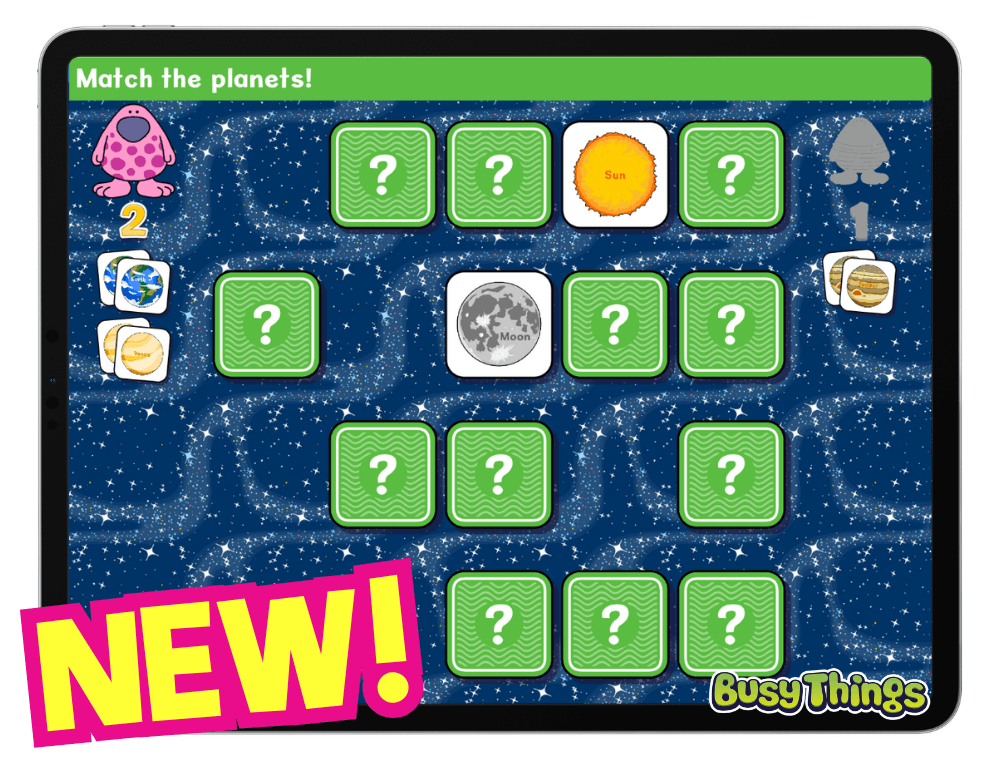
NEW! Match the Planets on Busy Things
Help children get to know the planets with our new matching-pairs games! Match the Planets can both be played solo or with a friend.
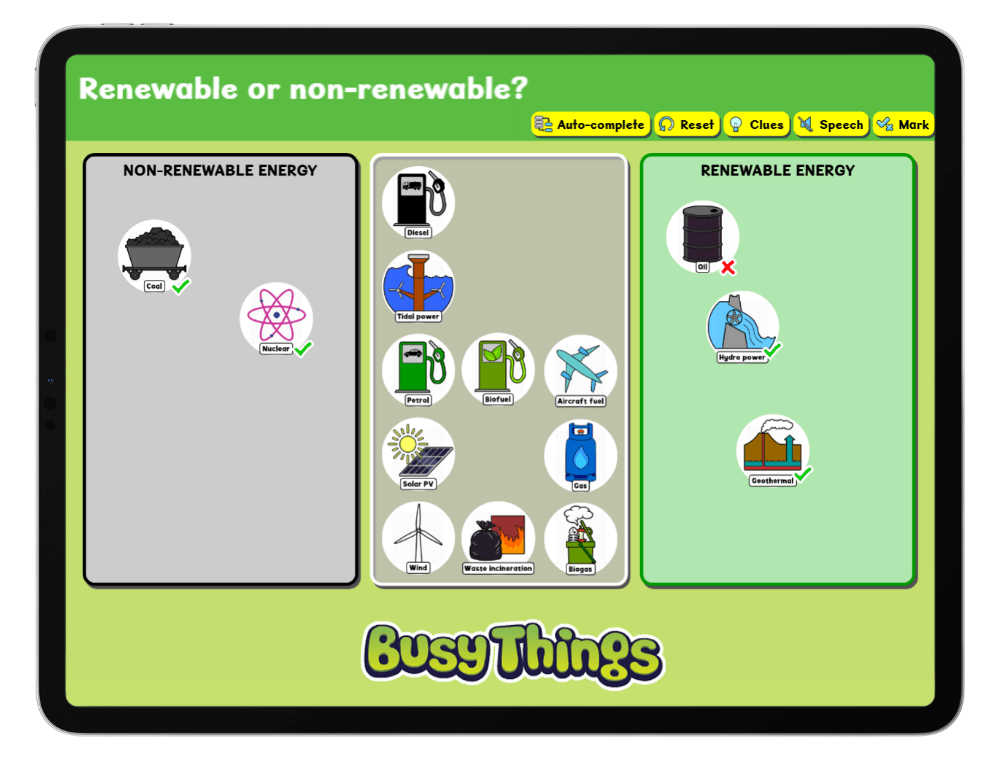
Renewable and non-renewable energy on Busy Things
Use the renewable and non-renewable energy activity on Busy Things to sort different energy sources and see which ones will run out and which won’t.
5: Earth from Above – Paint Your Planet
See Earth from a different perspective
This “Earth from Above” activity gets children thinking about what our planet looks like from space. Ask them to imagine they’re in a satellite looking down at Earth, then paint what they can see.
What You’ll Need:
- Blue, green and white paints
- Paper
- Markers
How to paint the Earth:
- Start with a large blue circle for the oceans.
- Add green shapes for land, then white for clouds and ice.
- You can keep it realistic or let them add their own details – cities, forests, animals, their favourite landmarks or even imaginary features.
Use a world atlas to explore Earth’s layout and find your home – it’s a fun way to connect your child’s artwork with real-world geography!
Fun space facts
Satellites in space take pictures of Earth to help scientists track changes, like how much ice is melting or how forests are disappearing. By seeing Earth from space, we can understand climate change better and take steps to protect our planet. Check out the European Space Agency’s Earth Observation Portal for fascinating insights into how satellites monitor our world.
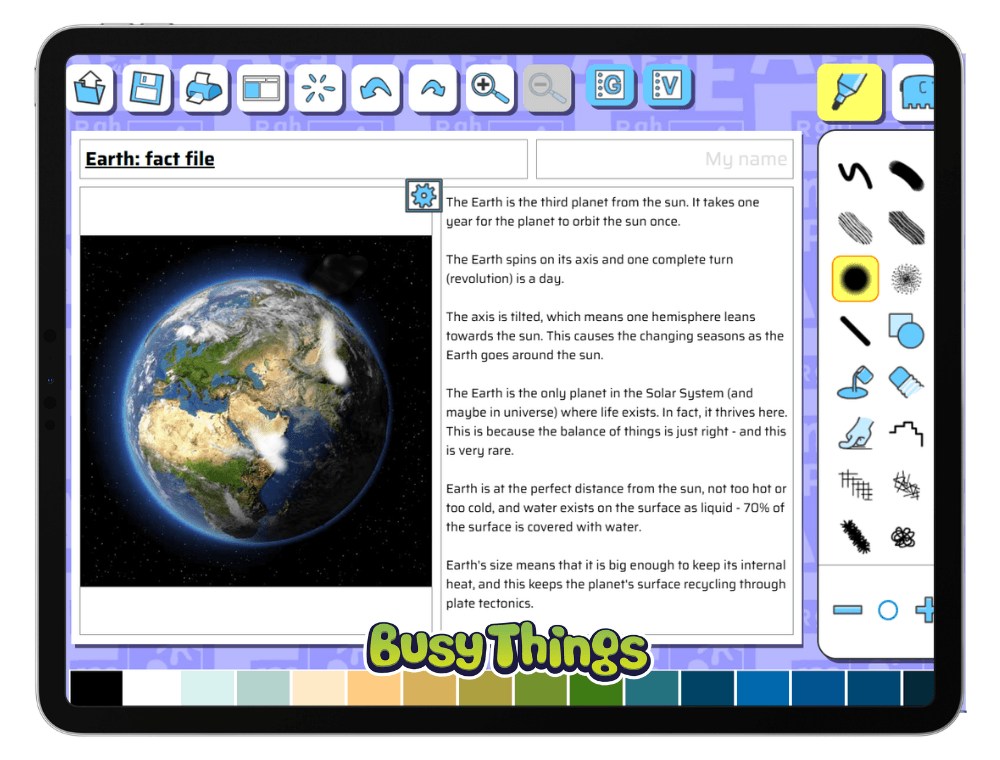
Create an Earth Fact File on Busy Things
What do your children know about planet Earth and its moon? Choose a template and use the text and picture tools to create a factsheet.
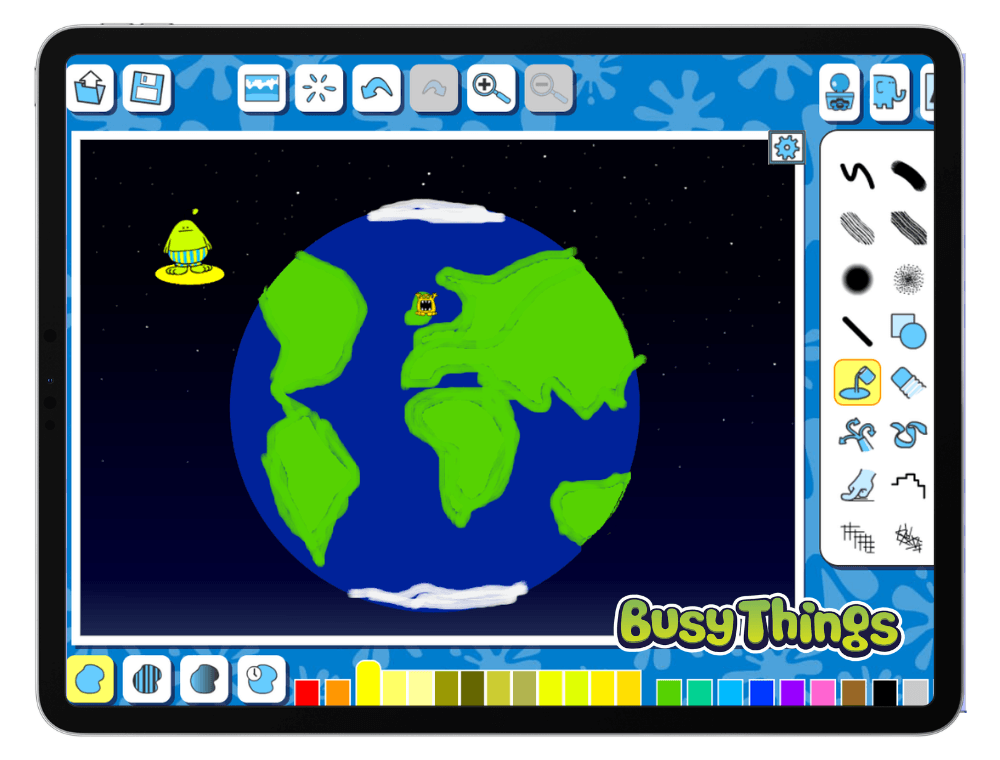
Paint Earth on Busy Things
Create a digital version of the Earth using Busy Paint. They can experiment with colours, shapes and tools to recreate what they think the planet looks like from space, or add their own details.
6: Astronaut Fitness Challenge – Space Walk Obstacle Course
Move like an astronaut!
Astronauts don’t just float around… working in space takes strength, control and coordination. This activity is a simple way to get children moving while thinking about what it’s actually like to work in space.
What You’ll Need:
- Pillows
- String
- Chairs
How to set up your space walk:
Create a simple obstacle course using what you’ve got at home.
- Pillows can be “moon rocks”
- String or tape can be “laser beams” to step over or avoid
- Chairs can be “space stations” to move around
Challenge them to move through the course like an astronaut – slowly, carefully, and as if they’re in low gravity.
You could add some space-themed music, or turn it into a game of musical space bumps as they move around the course.
Fun Space Facts:
Astronauts have to stay very fit. In space, there’s very little gravity, so even simple movements can be difficult to control.
They train to stay strong and coordinated so they can carry out tasks like repairing equipment, moving safely outside spacecraft and running experiments.
Search for Astronaut interviews, such as this one with Tim Peake, to learn more about what life in space is like.
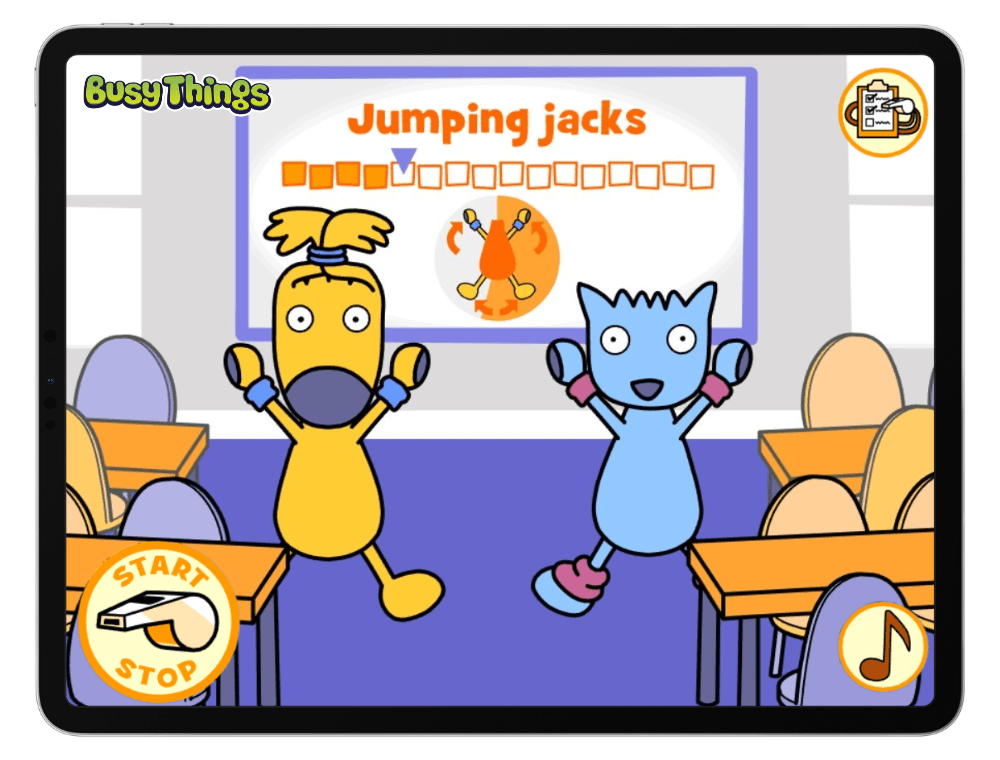
Workout with Dog and Cat on Busy Things
Try the Workout with Cat and Dog activity on Busy Things for a guided movement session. It’s a quick, easy way to keep them active.
7: Stargazing – Look up and explore the night sky
Take a closer look at the night sky
You don’t need any equipment for this one, just a clear evening and a few minutes outside or by a window. This is a simple way to slow things down and actually look at what’s above us. It helps children connect what they’ve been learning to something real.
What You’ll Need:
- Blankets or somewhere comfortable to sit
- Warm clothes if it’s cold
- Hot chocolate (optional but recommended!)
- Stargazing app or simple star map (optional)
How to Stargaze:
- Get comfy and look up.
- See what you can spot – you might notice bright stars, patterns or even moving lights (which could be satellites). You might even catch a shooting star.
- You could try to find a simple constellation, or just spend a bit of time noticing what the sky looks like.
- If the weather isn’t great, you can still do this by looking at photos or using a stargazing app instead.
- Sip some hot chocolate and talk about how scientists use telescopes and satellites to study space and learn more about our planet.
Watch this video for stargazing tips for beginners.
Fun space facts:
The stars you can see are part of our galaxy. Many are much bigger and brighter than our sun, but they look small because they are so far away.
Planets can sometimes be seen in the night sky too. Unlike stars, they don’t twinkle in the same way.
Light from some stars takes years – sometimes thousands of years -to reach Earth. When you look at the sky, you’re seeing light that left those stars a long time ago.
To learn more on sky watching visit NASA and NASA’s Climate Kids.
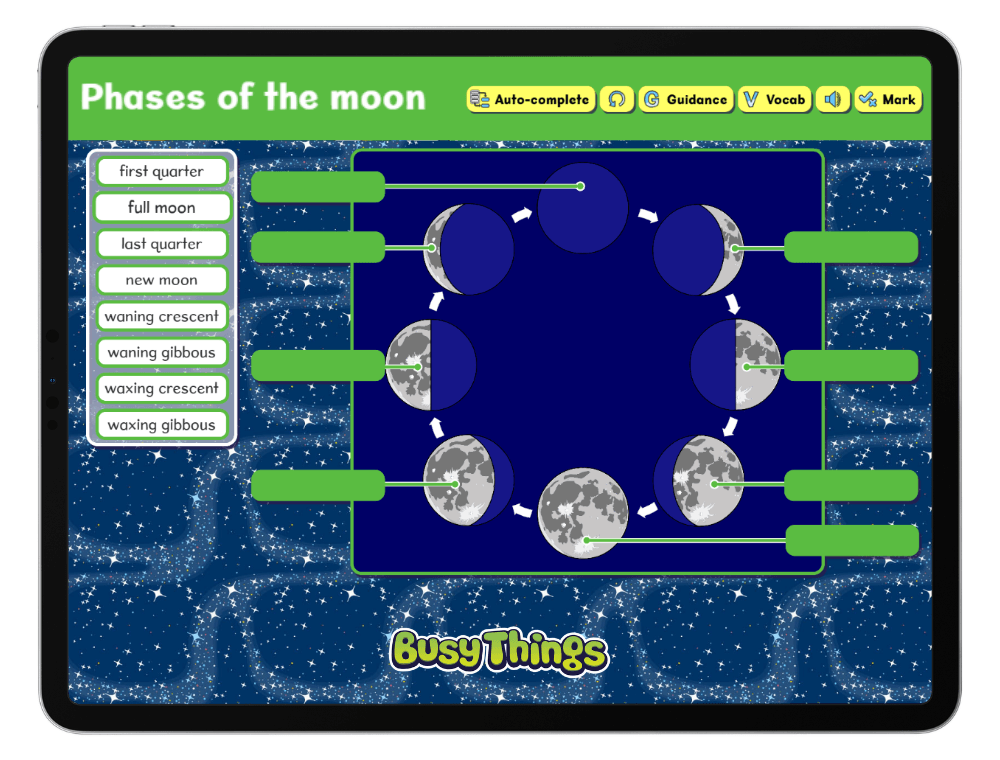
Solar system vocabulary on Busy Things
Why does the Moon look different throughout the month? Children can explore the different phases of the Moon with this interactive Busy Things activity, discovering how its appearance changes as it orbits the Earth.
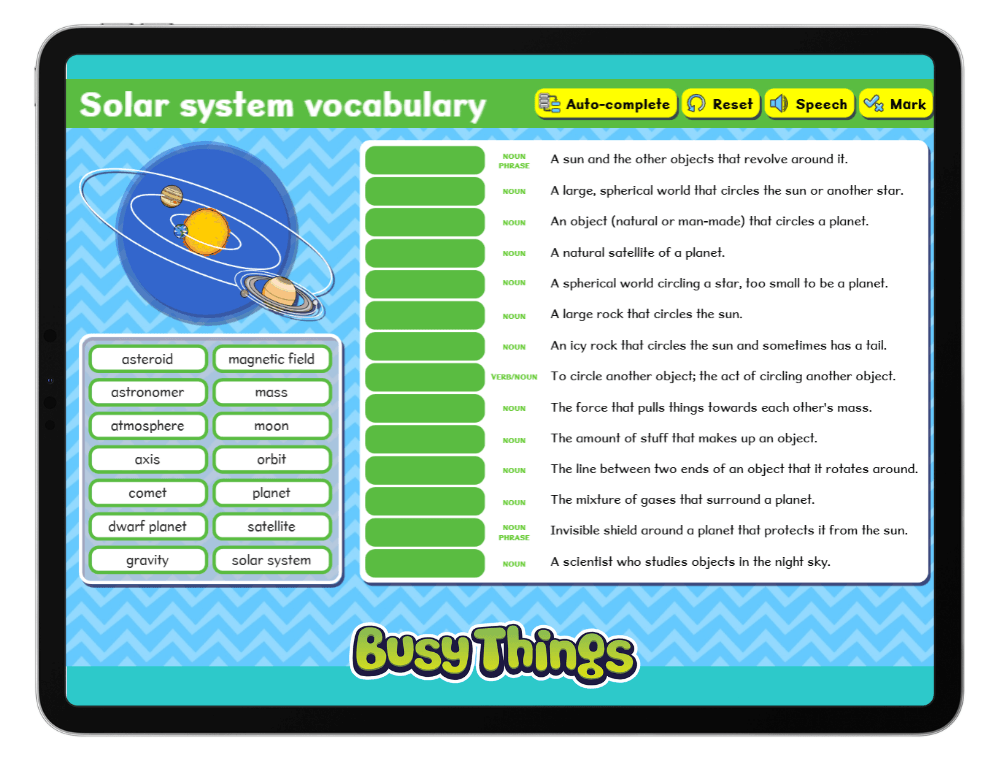
Solar system vocabulary on Busy Things
Match space vocabulary to the correct definitions with this interactive activity. It’s a great way to consolidate what they’ve been seeing and talking about and they’ll get instant feedback as they go.
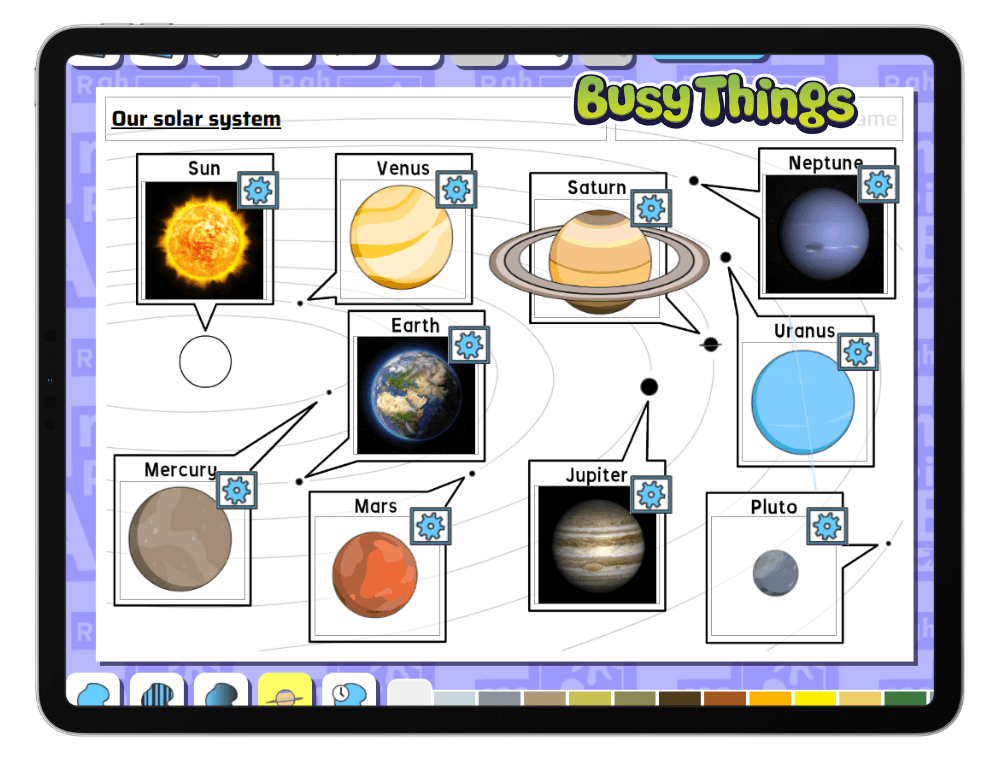
Solar System Fact Files on Busy Things
Use the fact file templates to create a simple overview of the solar system or individual planets. Add key facts, images and labels to show what they’ve learned.
Download Your Free Space Activity Pack
Ready for more space ideas?
If you’re looking for a few more easy space ideas, download the Free Space Activity Pack! It’s packed with printable space-themed puzzles, crafts, and STEM challenges that will keep the excitement of space exploration going.
You might also like our Space themed activities – ideas to really make their space-day! blog too!
Explore More Space-Themed activities on Busy Things!
Log in to Busy Things to explore more space-themed activities. Discover a galaxy of space-themed games, planet fact files, spaceship design challenges, and quizzes.
Not a Busy Things subscriber yet? Start your free trial today and explore hundreds of engaging and educational activities designed to spark curiosity and learning!
4 Replies to “7 Easy Space Activities for Children to Try at Home”