5 fun, classroom-ready activities for Shakespeare Week
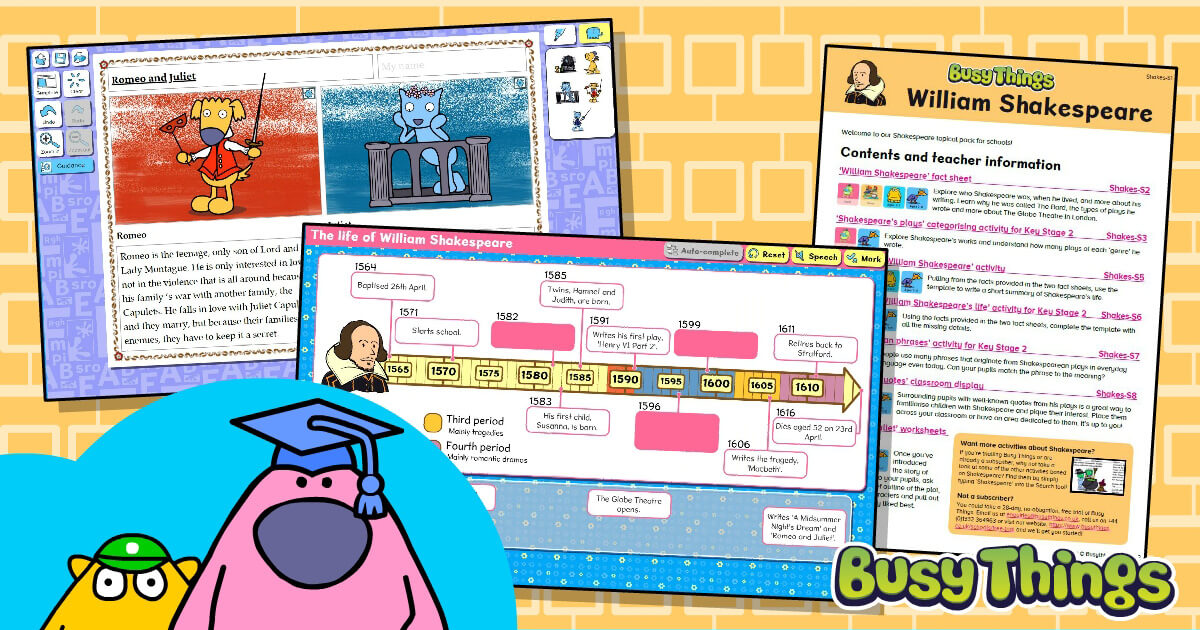
Planning Shakespeare Week doesn’t have to mean hours of extra preparation.
Shakespeare Week 2026 runs from the 23rd to 29th March and is organised by the Shakespeare Birthplace Trust. With no set theme this year, teachers are free to celebrate in whatever way works best for their class, whether that’s exploring a favourite play, learning about Shakespeare’s life or dipping into his wonderfully quirky language.
To help make planning easier, we’ve pulled together five classroom-ready activities from Busy Things’ Literacy and History areas. They’re designed especially for primary school pupils and can be mixed and matched to suit your learners, saving you time while keeping lessons engaging and meaningful.
The five areas of learning we’ve selected are:
1. Shakespeare’s life
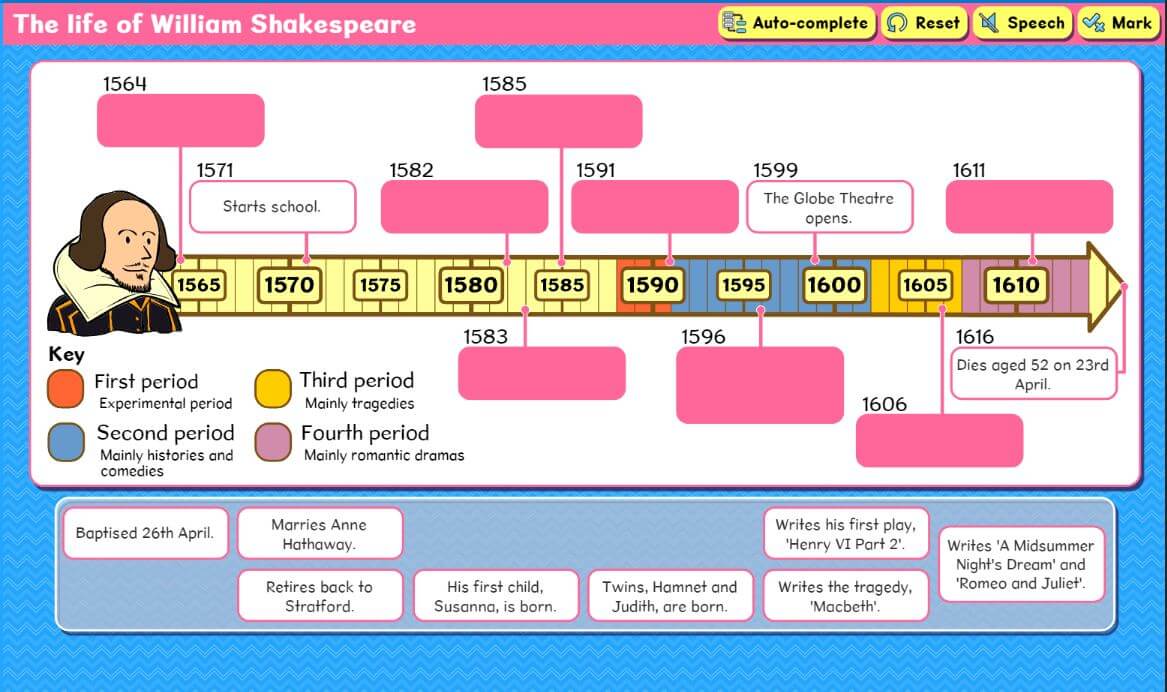
William Shakespeare was born in April 1564 and died, aged 52, on 23rd April, 1616.
He wrote his first play in 1590 and wrote at least a further 38 plays in his 20-year career.
Find out more about how his writing developed over time with our ‘Timeline of William Shakespeare’s life’ labelling activity.
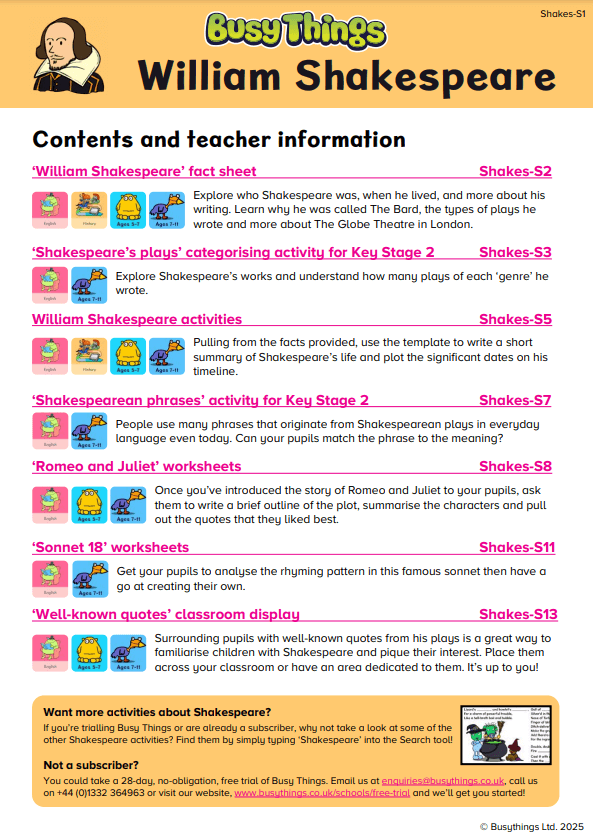
Not sure you’ve got enough facts to complete the activity? The summary of his life in our topical pack is a good reference document.
Access our ‘Timeline of William Shakespeare’s life’ activity here!
2. Shakespeare’s plays
Shakespeare wrote histories, comedies, tragedies and romantic dramas, as well as poems and sonnets.
Which, if any, have your pupils heard of?
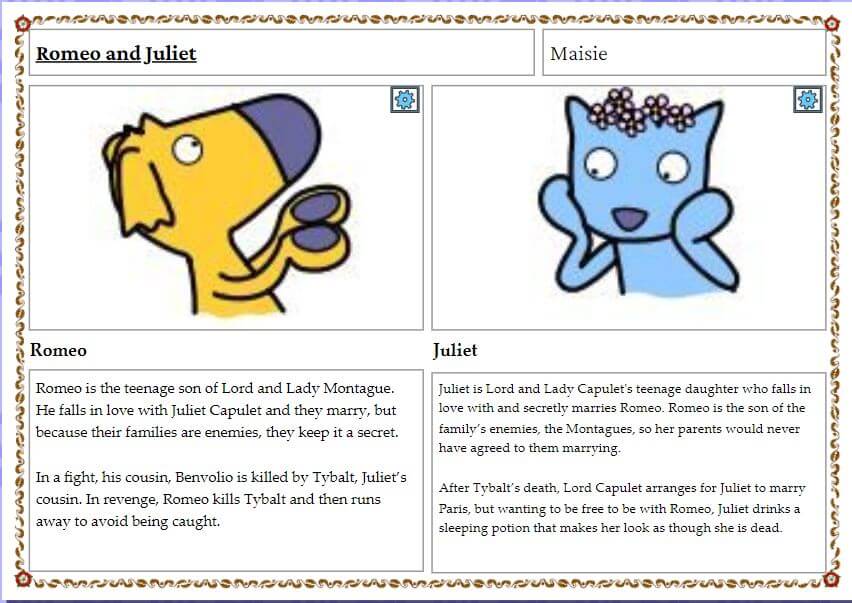
Macbeth, Romeo and Juliet, and Midsummer Night’s Dream are some of the most popular for primary schools to start with because their themes are easy to understand.
Busy Things has writing projects and worksheets on all of these three plays. Take a look and see if you could use them in your lessons!
Not sure where to start? Our blog “Shakespeare Week: How to Introduce Children to Shakespeare” may give you some inspiration.
3. Shakespeare’s language
The language Shakespeare uses in his plays often prevents children from following the storyline, which is why it’s often best to see them performed rather than to read them.
Having said that, many of the phrases first seen in Shakespeare’s works have now become ingrained in everyday English.
We explore some of his best known turns of phrase, such as ‘fair play’ and ‘in a pickle’ in our Shakespeare topical pack.
Note: If the children get struggle with the language, there are Shakespeare -> English translation websites online.
4. Shakespeare’s theatre
As well as writing plays, Shakespeare is famous for his London theatre, The Globe, which is situated on the River Thames.
His theatre company commissioned its construction, and his plays were performed there from 1599 onwards until a fire burnt it to the ground in 1613.
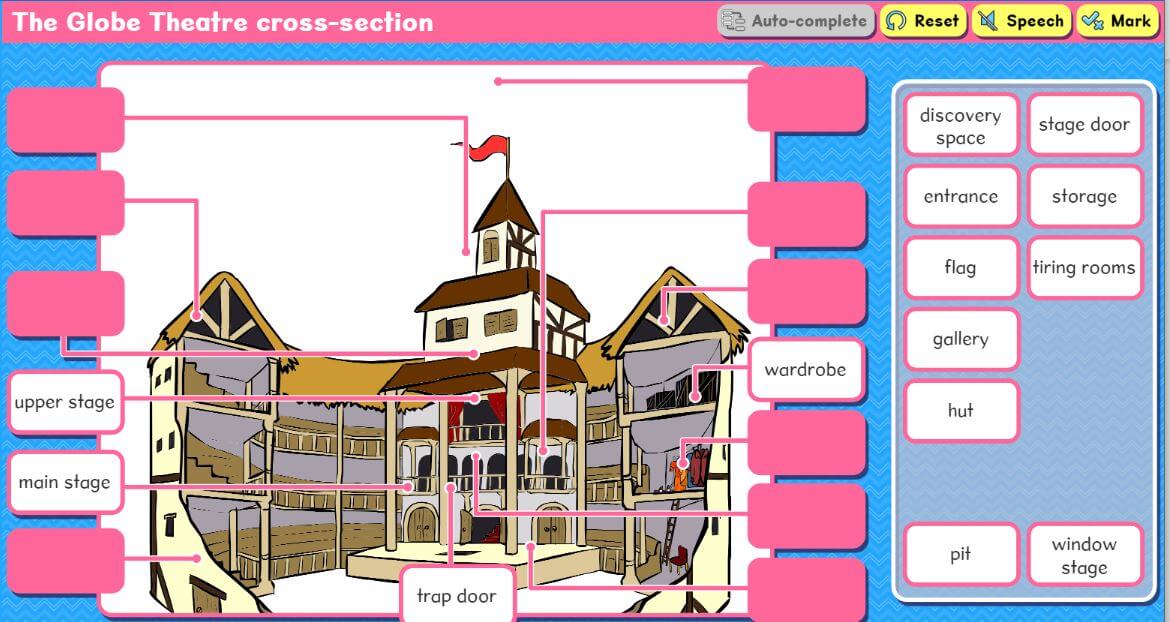
Pupils can explore the detail of the theatre (which is identical to the theatre that stands in its place today) in our ‘The Globe Theatre’ labelling activity.
Alternatively, they could create a fact file using our ‘Write about the Globe Theatre’ writing activity.
5. Questions you’d ask Shakespeare
Do your pupils still have questions that remain unanswered? Wouldn’t it be great to be able to ask the man himself? We thought so, which is why we developed our Interview William Shakespeare activity!
Harnessing A.I., the activity allows pupils to type in the questions they really want answered, and Shakespeare replies. It’s a great way to deepen children’s understanding of life in Tudor times and life as a playwright. Critically, the children get to find out more about the aspects of his life they are interested in.
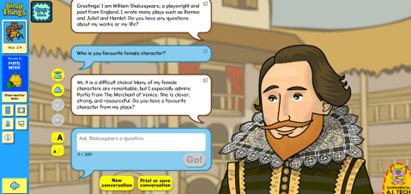
Please note: As with all A.I., there is a small risk that this activity will perform less than perfectly. We therefore recommend that you test it out before your pupils. If you are unhappy with the results, you can decide not to use the activity and turn all A.I. content off in your global settings.
Summary
Whether you use just one activity or build a whole week around them, we hope these ideas help make Shakespeare Week both enjoyable and stress-free.
As part of the blog, we’ve made the Timeline of William Shakespeare’s life activity free to play until the end of Shakespeare Week, and also given you access to our William Shakespeare topical pack. To visit them, just click on the links.
Want to see more of our Shakespeare activities (and others)?
If you’d like to explore even more Shakespeare resources, simply search “Shakespeare” on the Busy Things home page or head to March > Shakespeare Week in the Special Events area, where you can pin or favourite everything in one go.
Don’t yet have a Busy Things login? Start a free 28-day trial here and access all our Shakespeare activities, plus thousands more engaging, curriculum-linked resources.
This blog was revised and updated in February 2026.