Teaching Children How to Tell the Time: A Step-by-Step Guide
Why does the 4 mean 20? It seems so obvious until your child asks you to explain it!
Teaching children how to tell the time can be tricky. There are two hands doing different jobs and the same numbers mean different things depending on which hand you’re looking at – it’s easy to forget just how confusing clocks can be for a child!
Learning takes time… Your child might be perfectly happy with o’clock and half past but completely baffled by quarter to. Or they might read digital times without a problem but struggle with an analogue clock.
The trick is working out which bit isn’t clicking. Once you’ve found that, you can try explaining it another way and give them something useful to practise.
Which bit of telling the time is your child finding tricky?
If your child keeps getting stuck on something, jump straight to the explanation you need:
- Confusing the hour and minute hands?
- Why does the 4 mean 20?
- Struggling with quarter past and quarter to?
- What’s the difference between minutes past and minutes to?
- Can read digital time but not analogue?
- Not sure what your child should practise next?
- Looking for fun ways to practise telling the time at home?
- Looking for a hands-on activity? Get your free make-a-clock printable.
Otherwise, let’s start at the beginning…
How to start teaching your child to tell the time
First, make time mean something

Before jumping into the details of a clock face, it helps if children have a feel for the concept of time itself.
Start with the familiar bits of their day. Talk about morning, afternoon and evening, and the things that happen at different times. Breakfast comes in the morning, bedtime happens at night, and swimming lessons might be after school – this starts off the idea of blocking time into sections.
Explore how long things take
Everyday activities are a brilliant way to explore the passage of time and start noticing how long things take.
- Look at the clock when a favourite programme starts and finishes. How long was it on for?
- Set a five-minute timer before you need to leave the house.
- Do some baking together and set the oven timer. How long until the cakes are ready?
- Time how long it takes to eat breakfast, brush their teeth, get dressed or tidy away their toys.
Timing familiar activities helps children get a feel for how long five minutes, ten minutes or an hour actually lasts. It gives those numbers on the clock some meaning, rather than them simply being something to remember.
And once you’re ready to tackle the clock face, introduce one thing at a time.
How to read an analogue clock: start with the hour hand
We’re surrounded by digital clocks these days – on phones, computers, TVs and even ovens. But an analogue clock is particularly useful when teaching children to tell the time because they can see how the hands move as time passes, how the clock is divided into sections and how these relate to counting in five-minute intervals.
Start with the short hour hand. Try covering the minute hand so your child can concentrate on recognising the hours without getting distracted by it.
Once they’re confident with o’clock, introduce half past.
Why isn’t the hour hand pointing exactly at the number?
Here’s something that often catches children out: the hour hand never actually stops moving, it doesn’t jump from one number to the next. It moves gradually throughout the hour.
At 3 o’clock, the little hand points directly at 3. By half past 3, it’s halfway towards 4. And at quarter to 4, it’s almost there.
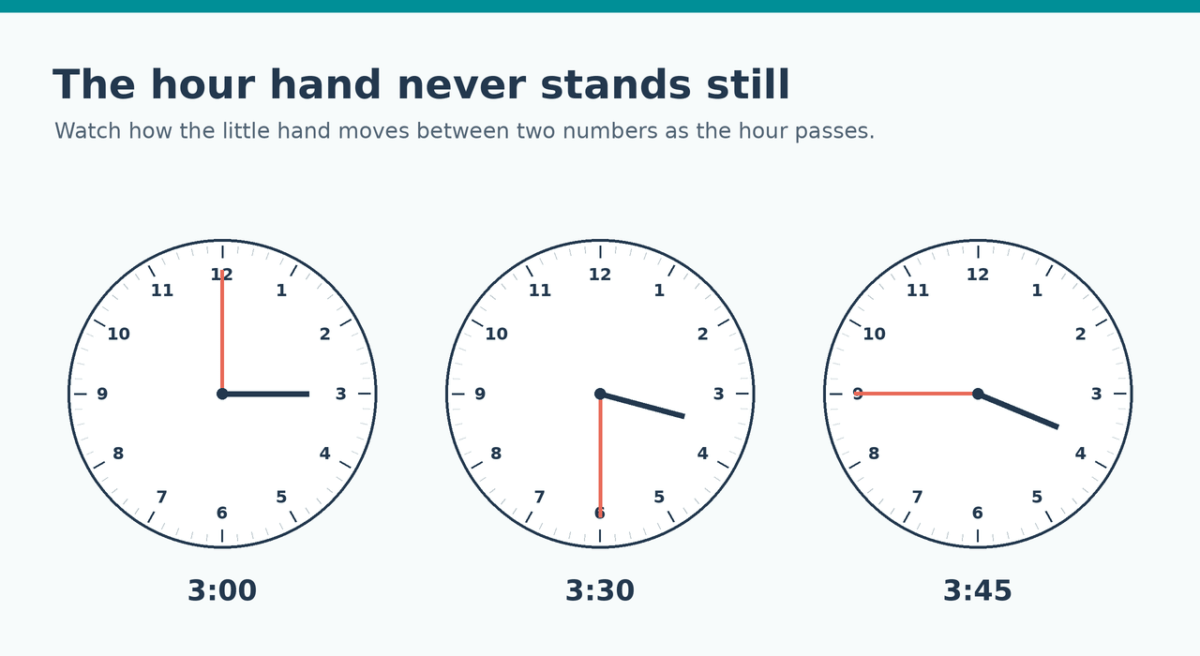
If your child keeps reading the wrong hour, try showing them this movement rather than simply correcting their answer.
Start at 3 o’clock and slowly move the clock forwards through the hour. Watch how the little hand creeps towards 4, only reaching it when the minute hand has made a complete turn.
Ask, “Has the little hand reached 4 yet?” If not, it’s still three-something!
This helps children understand why the hour hand is often sitting between two numbers rather than pointing directly at one.
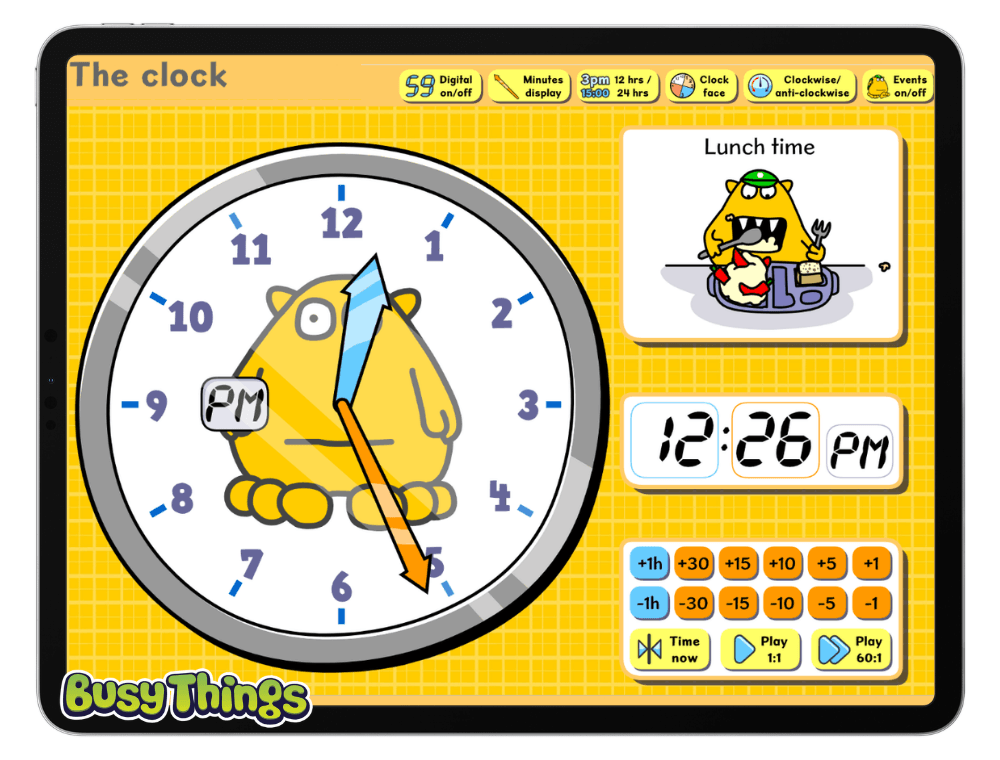
Try it with Busy Things: Our interactive Clock simulator lets you hide the minute hand to concentrate on hours, then bring it back and watch how the hands move together.
Try moving the clock forwards and asking your child to predict where the little hand will be next.
Why does the 4 mean 20? Understanding the minute hand
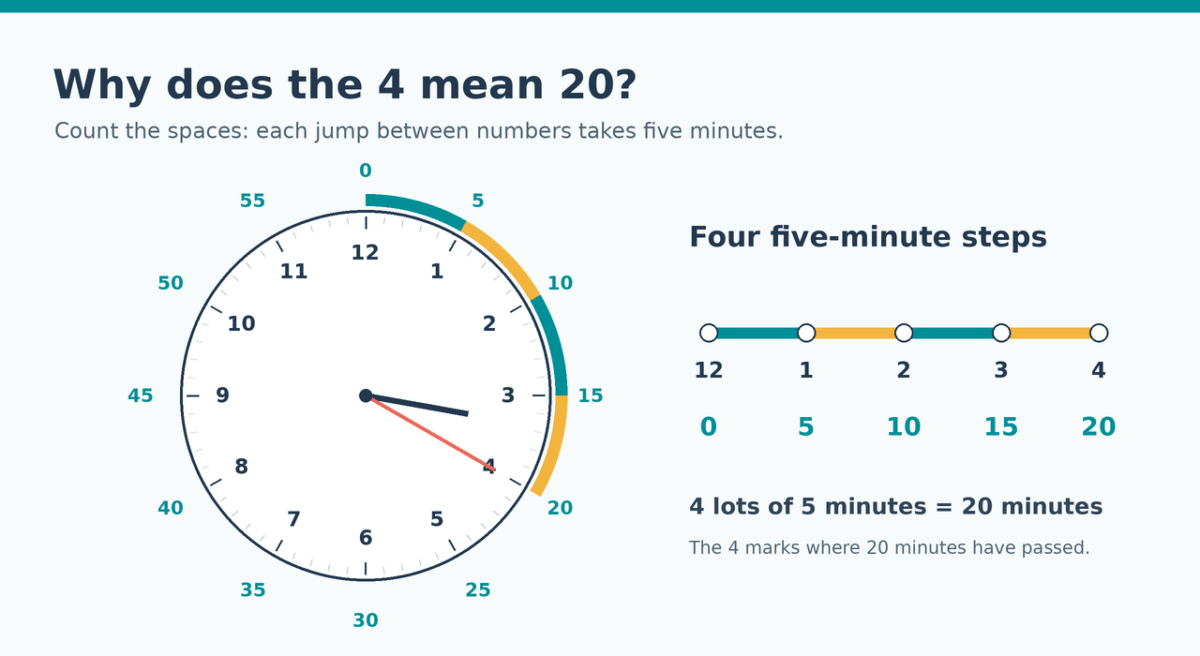
If your child is struggling to understand why the 4 represents 20 minutes, try getting them to count the spaces rather than memorise the numbers.
Start at 12 and move the minute hand to 1 — that’s five minutes. Move it to 2 — another five minutes. By the time they’ve reached 4, they’ve counted four lots of five minutes, making 20.
This helps children see where the 20 minutes come from, rather than simply learning that the 4 means 20.
Counting in fives makes everything easier
Being comfortable counting in fives makes reading the minute hand much easier.
If your child is getting stuck on the counting itself, practise that separately for a little while before coming back to the clock.
Try counting in fives with a song or a simple clapping game. Once they’re comfortable, point around the clock as you count together. Then try stopping at random numbers.
“If the big hand lands on the 7, how many minutes is that?”
Our Fun Ways to Practise Times Tables at Home blog has plenty of ideas if your child needs a little extra help getting those fives to stick.
It also helps if children are confident counting from 1 to 60, particularly when they start telling the time to the nearest minute. If they’re still getting muddled with double-digit numbers, try practising counting during everyday activities before tackling more precise times.
What about the little marks between the numbers?
Have you noticed the small marks around the edge of some clocks? On clocks with 60 evenly spaced marks, each one represents a minute.
If your child is ready to move beyond five-minute intervals, use these markings to show them how to read more precise times.
Start with the minute hand pointing at 4 (20 minutes past), then move it two little marks further. It’s now 22 minutes past.
Not all clocks have these marks, but they’re particularly handy for practising telling the time to the nearest minute.
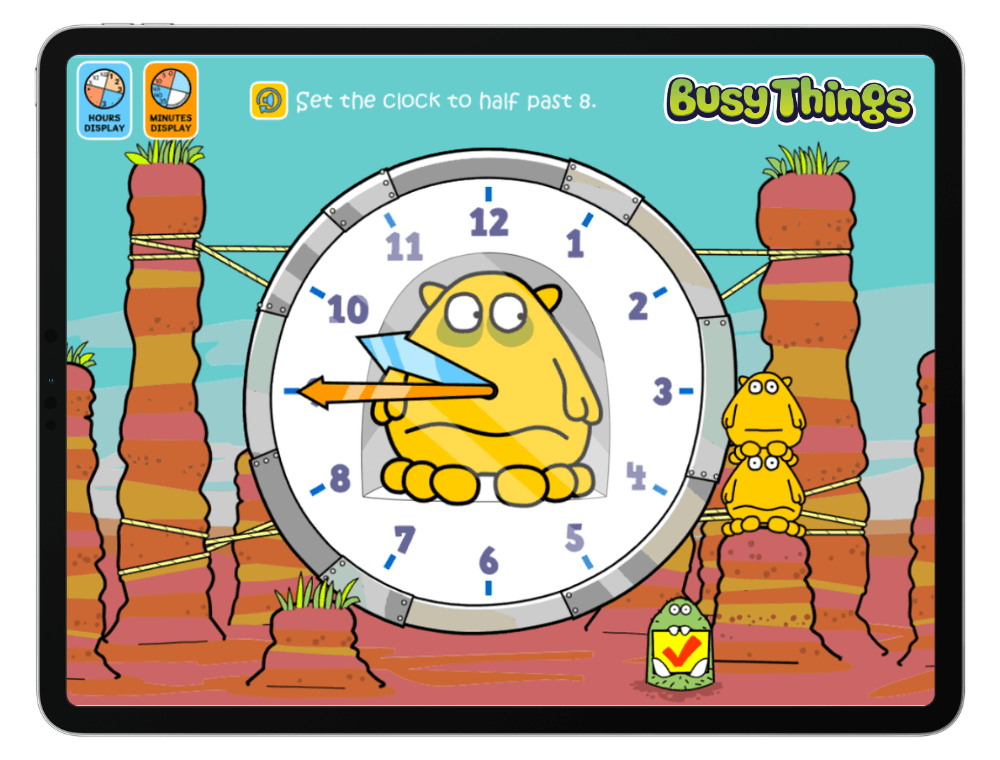
Time to practise! Try Crunch Time on Busy Things. You can set the game to five-minute intervals to practise counting in fives, then move on to one-minute intervals when your child is ready for a bigger challenge.
Quarter past, half past and quarter to: what’s the difference?
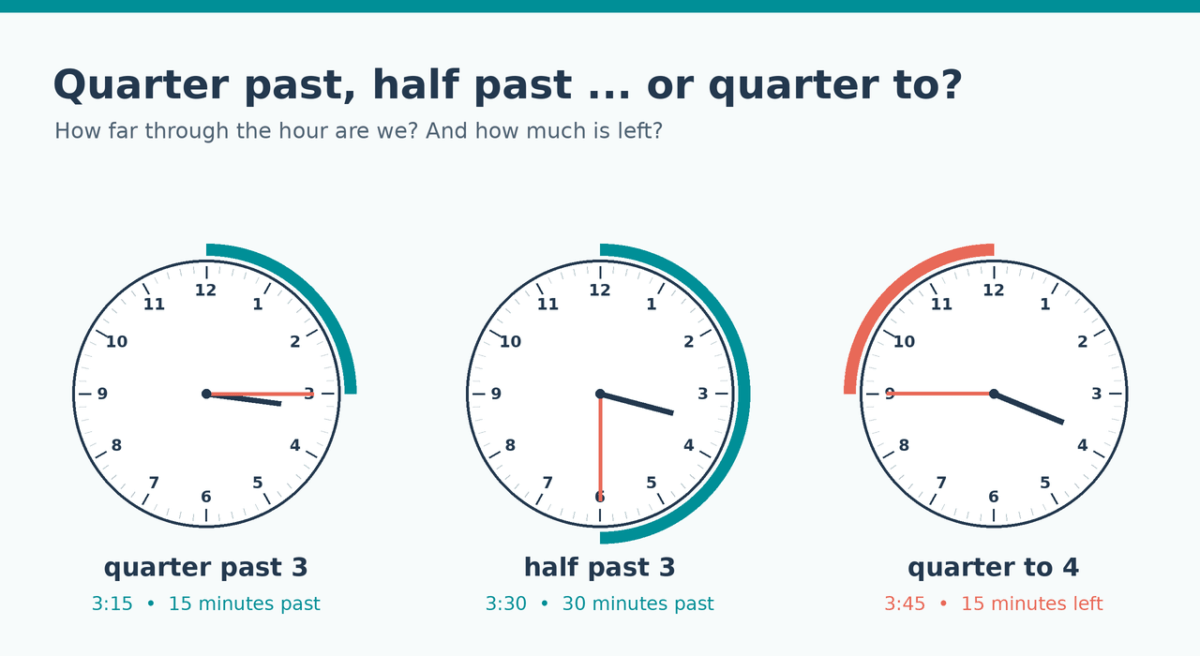
If your child is struggling with quarter-hour times, try making the quarters something they can actually see.
Cut out a paper clock face and fold it in half, then in half again. Open it out and you’ll have four equal sections, each representing 15 minutes.
Use the folds to help your child set quarter past, half past and quarter to, and see how much of the hour has passed.
How do I explain quarter to?
This is often where children get confused. They’re used to talking about the hour that’s already started, but quarter to refers to the hour that’s coming next.
If your explanation isn’t getting through, try putting the clock aside for a moment.
Think about something familiar, like “15 minutes until dinner” or “10 minutes until we leave”. You’re talking about how much time is left before something happens.
Quarter to works in exactly the same way.
Now set a clock to 3:45 and ask, “Have we reached 4 o’clock yet?”
Move the hands forwards until the minute hand reaches 12 and the hour hand reaches 4. That remaining quarter of the clock represents the 15 minutes left until four.
It’s a simple way to show why quarter to 4 is 3:45, rather than just asking children to remember it.
Make your own clock and give it a try
A clock with movable hands is particularly useful for exploring these ideas, and making one can be part of the fun!
Download our free Make Your Own Clock printable, with a clock face and hands to cut out and put together. Once it’s ready, challenge your child to show quarter past, half past and quarter to, moving the hands to explore how the time changes.
Once your child is getting the hang of quarter-hour times, try Crunch Time on Busy Things. They can help a monster escape by reading clocks or setting the hands to different times. Start with whole, half and quarter hours, then increase the difficulty when they’re ready.
Minutes past and minutes to: why do we change halfway round?
Once your child understands quarter to, you can use the same idea to introduce other times approaching the next hour.
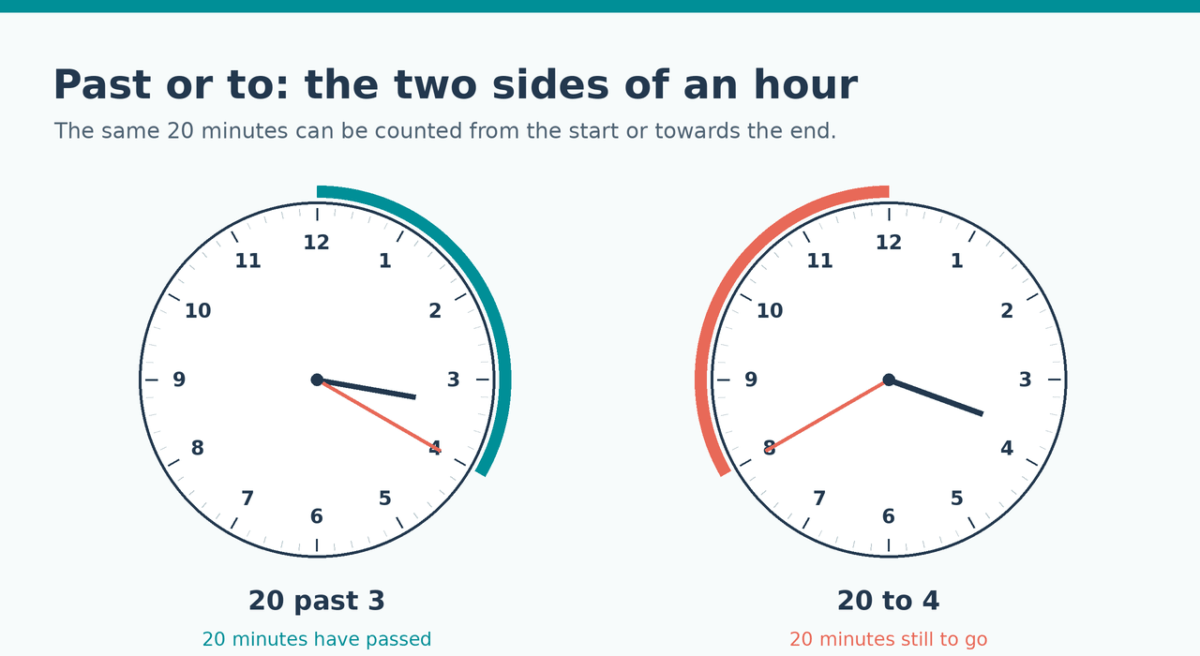
If your child keeps muddling up past and to, try focusing on the difference between how much time has passed and how much is still to come.
Try counting forwards instead of backwards
At 3:40, for example, there are 20 minutes left until 4 o’clock.
Rather than asking them to count backwards from 60, try counting forwards from wherever the minute hand is pointing.
Set the clock to 3:40 and ask: “How many five-minute jumps until the big hand gets back to 12?”
Count forwards together: 5, 10, 15, 20.
That makes 20 minutes to four.
You could also compare it to a journey. At twenty past, we’re talking about how far we’ve travelled since the hour began. At twenty to, we’re talking about how far we have left to go.
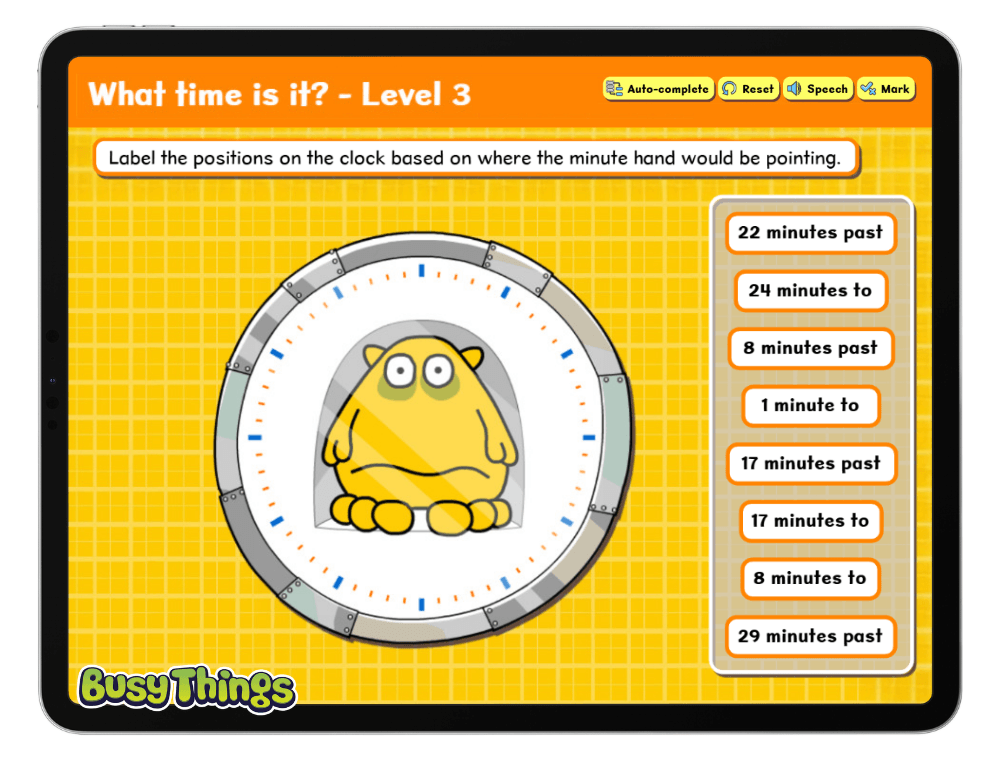
Ready for a challenge? Try Busy Things’ What Time Is It? interactive worksheet. Children match minutes past and minutes to with the correct positions around the clock, helping them put their understanding into practice and get instant feedback.
My child can read digital time but not an analogue clock. What now?
Reading numbers on a digital clock and interpreting the position of moving hands are two different skills. If your child is confident with one but not the other, try connecting them rather than practising each separately.
Start by showing a digital time, such as 3:45.
Ask your child to find where the minute hand would point on an analogue clock. They can count around in fives until they reach 45.
Then ask where the hour hand should be. If 45 minutes have already passed since 3 o’clock, how close will it be to 4?
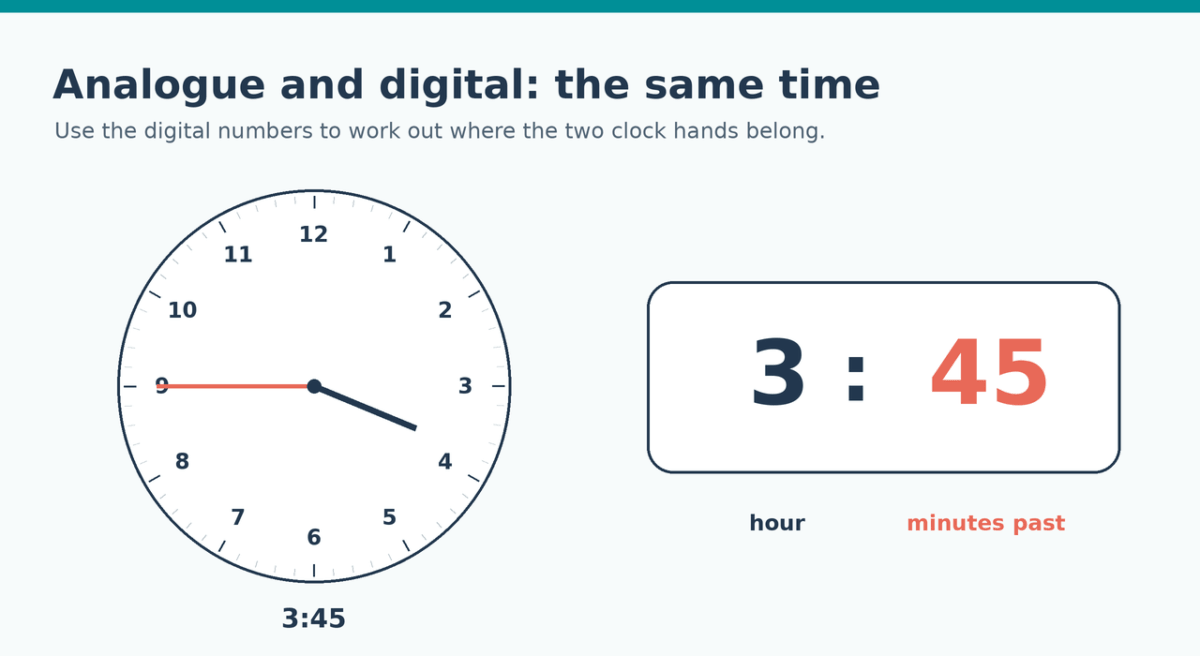
Working through the two parts separately helps children connect the numbers on the digital display with the positions of the hands.
Once they’ve got the hang of it, try reversing the challenge: show an analogue time and ask them to write the matching digital time.
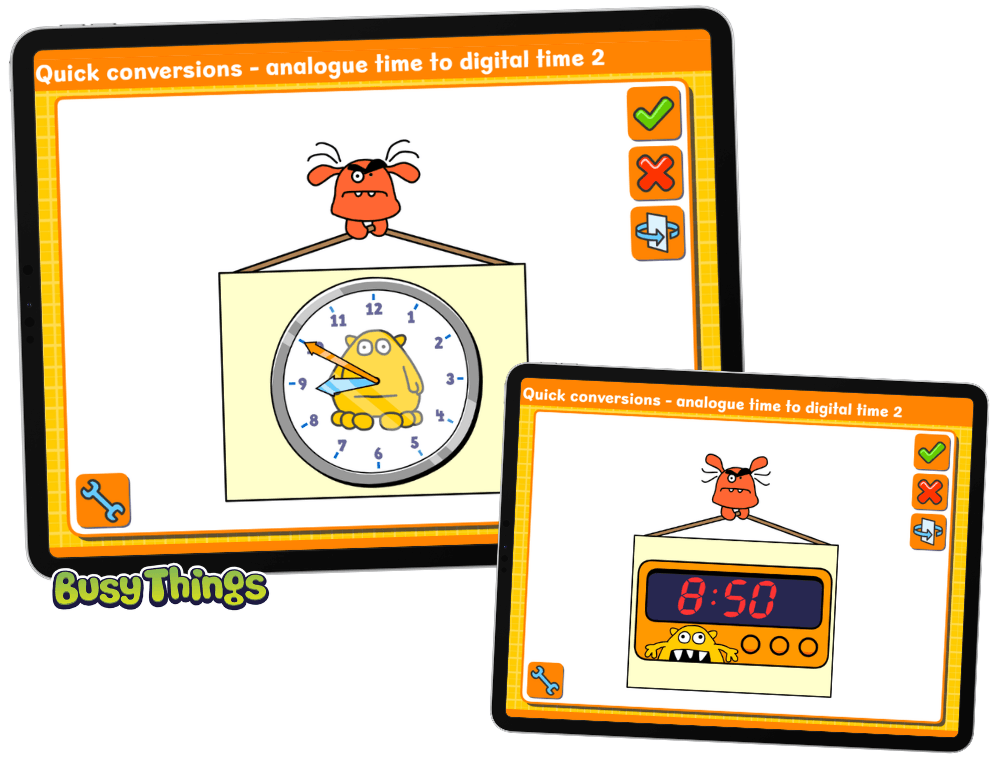
Try it with Busy Things: Our Quick Time Conversions flashcards are great for practising together. Show your child an analogue clock and challenge them to give the digital time, then reveal the answer.
What should my child practise next?
Once something clicks, it’s worth checking your child can use that skill in different ways before moving on.
For example, they might be brilliant at reading a clock but find it much harder to set the hands to a given time. That’s a useful clue about what still needs practising.
Here’s a simple progression to follow:
| If your child can… | Try next… |
|---|---|
| Recognise o’clock times | Half past, including where the hour hand moves |
| Tell o’clock and half past | Quarter past and quarter to |
| Recognise quarter-hour times | Counting minutes in fives |
| Read five-minute intervals | Minutes past and minutes to |
| Read times to five minutes | Individual minutes and analogue/digital matching |
| Confidently read analogue and digital times | 12-hour and 24-hour time, and working out how long things take |
Try mixing up the questions, too. Ask your child to read a clock, set the hands to a particular time or work out what time it will be in 15 minutes.
Each challenges them in a slightly different way and helps you spot anything they haven’t quite understood.
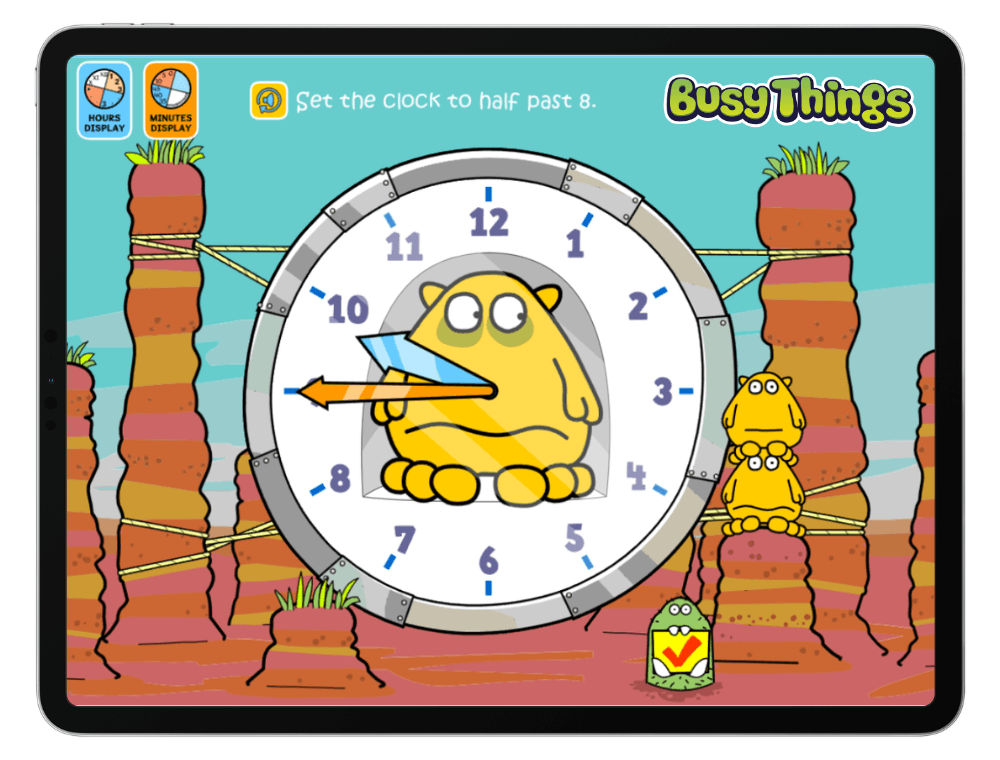
For extra practice, Crunch Time lets you adjust the difficulty and choose between reading and setting clocks. If your child is struggling with a particular skill, you can concentrate on that before moving on.
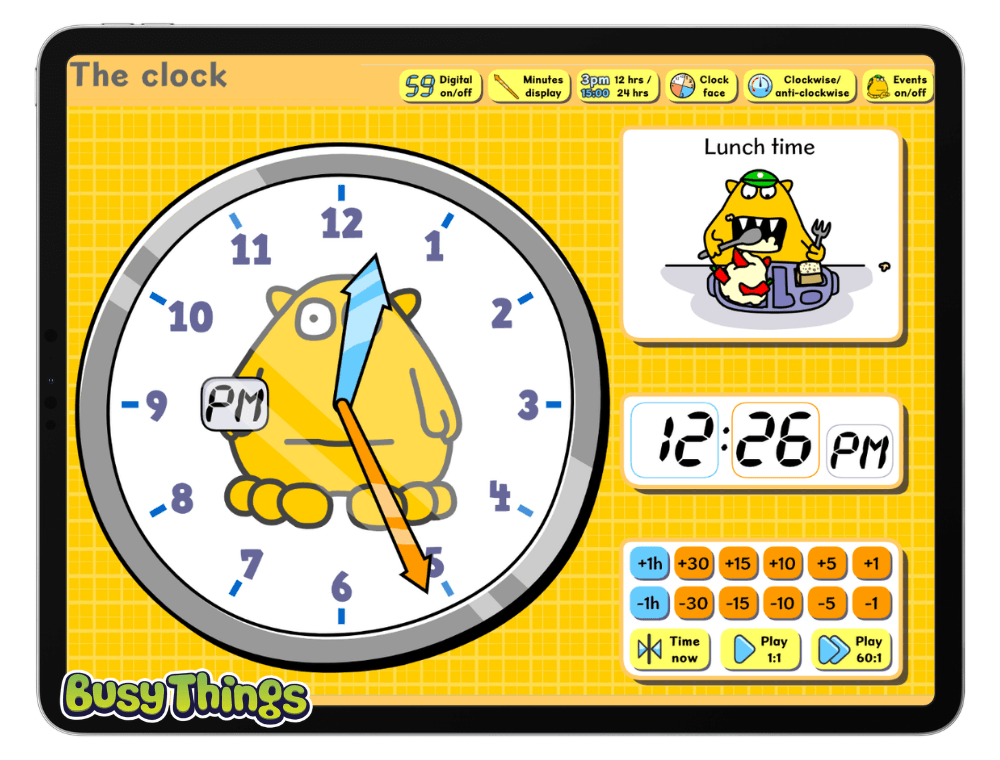
Finding anything tricky? The Clock simulator is a great teaching aid.
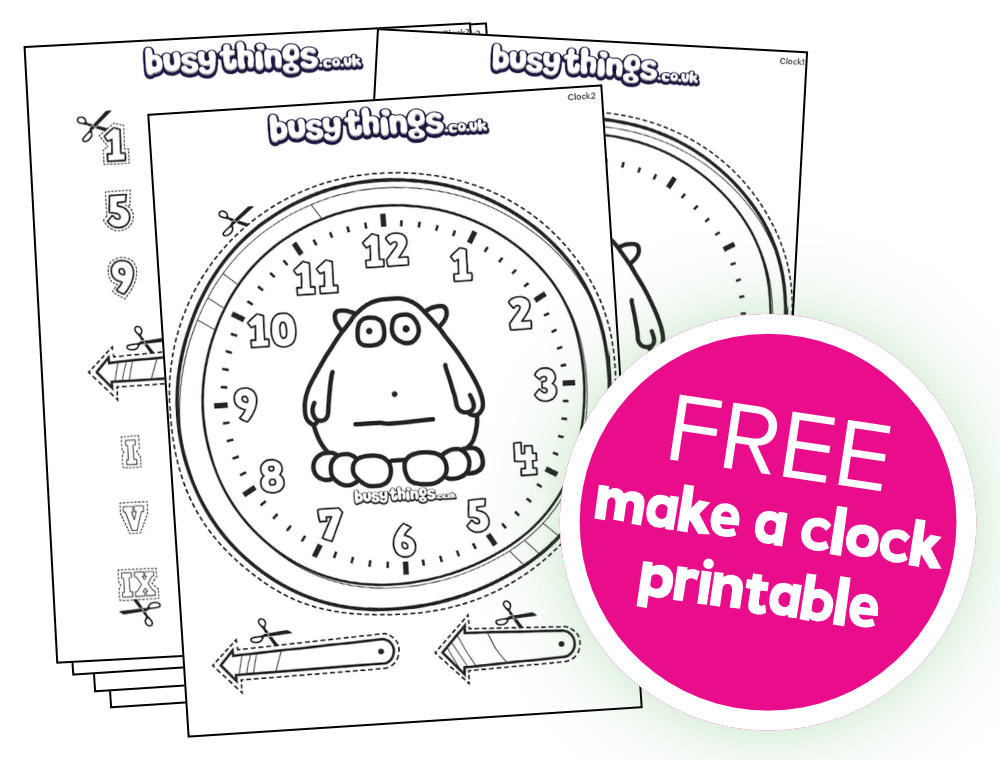
Prefer something hands-on? Our free make-a-clock templates let children practise setting the hands to different times and see how they move around the clock
What age should children learn to tell the time?
Wondering what your child should be learning at their age? Here’s a quick guide based on the maths curriculum in England.
NB: These are useful guides to what’s taught when, rather than a deadline for when every child should have mastered each skill.
| School year | What children are generally learning |
|---|---|
| Reception (ages 4–5) | Understanding daily routines and time-related language, such as before, after, morning and evening |
| Year 1 (ages 5–6) | Telling and showing o’clock and half-past times |
| Year 2 (ages 6–7) | Telling time to five minutes, including quarter past and quarter to |
| Year 3 (ages 7–8) | Reading clocks to the nearest minute, Roman numerals on clock faces, and 12- and 24-hour time |
| Year 4 (ages 8–9) | Converting between analogue and digital 12- and 24-hour clocks |
| Years 5–6 (ages 9–11) | Applying time skills to calculations, conversions and more challenging problems |
If your Year 4 child is still struggling with quarter to, for example, there’s little point pushing ahead with 24-hour conversions. Go back to the bit that’s causing trouble and build from there.
Five easy ways to practise telling the time at home
Here are a few simple challenges to help children practise what they’ve learnt during their everyday routines.
1. Make them the official timekeeper
If you’re going out at half past 10, ask your child to remind you when it’s time to get your shoes on.
You may find they’re particularly enthusiastic about this responsibility when you’re heading somewhere exciting — perhaps less so when it’s time for bed!
2. Try a five-minute guessing game
Show a time on a clock and ask what it will look like in five minutes. Then try 10 or 15 minutes.
Move the hands to check. This gets children thinking about how the clock changes over time, rather than just recognising individual times.
3. Set a time challenge
“We’ve got 20 minutes before we need to leave. What time will that be?”
Start with times that don’t cross into the next hour, then make things a little trickier.
4. Swap roles
Let your child set the clock and challenge you to read it.
Setting the hands is a different skill from reading them, so it’s a useful way to check their understanding. And a deliberately silly answer from you might make them even more determined to catch you out!
5. Notice the clocks around you
Look for clock faces when you’re out and about — at the station, in the swimming pool or on a town clock.
Can your child tell what time they’re showing? Can they find the same time on a digital display?
If they have an analogue watch or clock of their own, even better. Letting them choose one they really like can be a lovely way to get them interested.
Make your own clock – free printable
Put these ideas into practice with our free Busy Things make-a-clock printable. Cut out the clock face and hands, put them together and let your child try setting different times.
There are several clock designs to choose from, including versions with minute markings and Roman numerals.
Want online activities too? Try our telling-the-time activities on Busy Things.
A little practice goes a long way
Learning to tell the time involves several different skills, and children won’t necessarily grasp them all at once.
If something isn’t clicking, try showing it differently. Moving the hands, comparing two clocks or breaking the problem into smaller steps might be just what they need.
And when they’re ready to practise, Busy Things has plenty of activities to help them put those skills to the test, from exploring how a clock works to tackling trickier time challenges.
Try telling-the-time activities on Busy Things FREE for 7 days
No payment details needed, and no obligation to subscribe.
Who knows? You might even get a little less of “Is it time yet?“… although we’re making no promises about that one.
19 Replies to “Teaching Children How to Tell the Time: A Step-by-Step Guide”
Heya.
A clock is a great idea in order to start with. Alternatively you could get them to calculate arrival and departure times of trains. Another option is to make up ten questions using real life situations. Good luck.
For example time required to make up some party cakes. You can even have the kids answer questions on match times or time in general. You can even make up questions using a clock to teach movie times. Yet more options include lesson times and eating times. Questions on time must be made fun. Picnic and event times are other possibilities.
Great suggestions, thank you 🙂
I love these tips! The digital clock can really be tempting, but better to start with the basics. Thank you for sharing this
I’m so excited
Excellent recommendations and guidelines! We’ve found that audio books, ebooks and apps can also be beneficial to building skills and fostering a love of reading.
You’ve hit the nail on the head,Thanks
I love this blog! A lot of good info and well structured. Another one I can recommend is https://www.todaysparent.com/kids/school-age/fun-ways-to-teach-kids-to-tell-time/
A well-written, insightful article indeed! Thank you for sharing. Like your practical, easy-to-follow guide on raising a happy and successful child. Must share it with all my friends.
very helpful guideline for teaching how to tell the time regarding different junior age groups. I really appreciate your tips. Thanks a lot.
Good article. Some other thoughts…
I have had moderate success teaching 4–5 year olds to read a clock. This is an age that typically has limited or no experience at all with math, which is essential in reading a clock as adults do (counting by 5’s and 10’s). The first thing to establish with a child is recognizing the hands on a clock. Obviously one is bigger than the other and the two hands mean completely different things… however, it is possible (and actually effective with kids so young) to learn how to tell time with the hour hand alone.
Thank you for this article, you’ve got great ideas here for parents. I’m sure I can do this in addition to what the child is taught at school. I’ve shared this on facebook with my friends
Thanks for this awesome article, I read many articles on this topic. You can read this one also, It will be also beneficial to Parents: https://megaeducare.wordpress.com/2017/01/18/handful-tips-to-teach-child-to-tell-the-time/
This is a great list of ideas. Learning to tell time and keep on a schedule will help you child dramatically. Thanks for this great advice on teaching kids to tell time!